
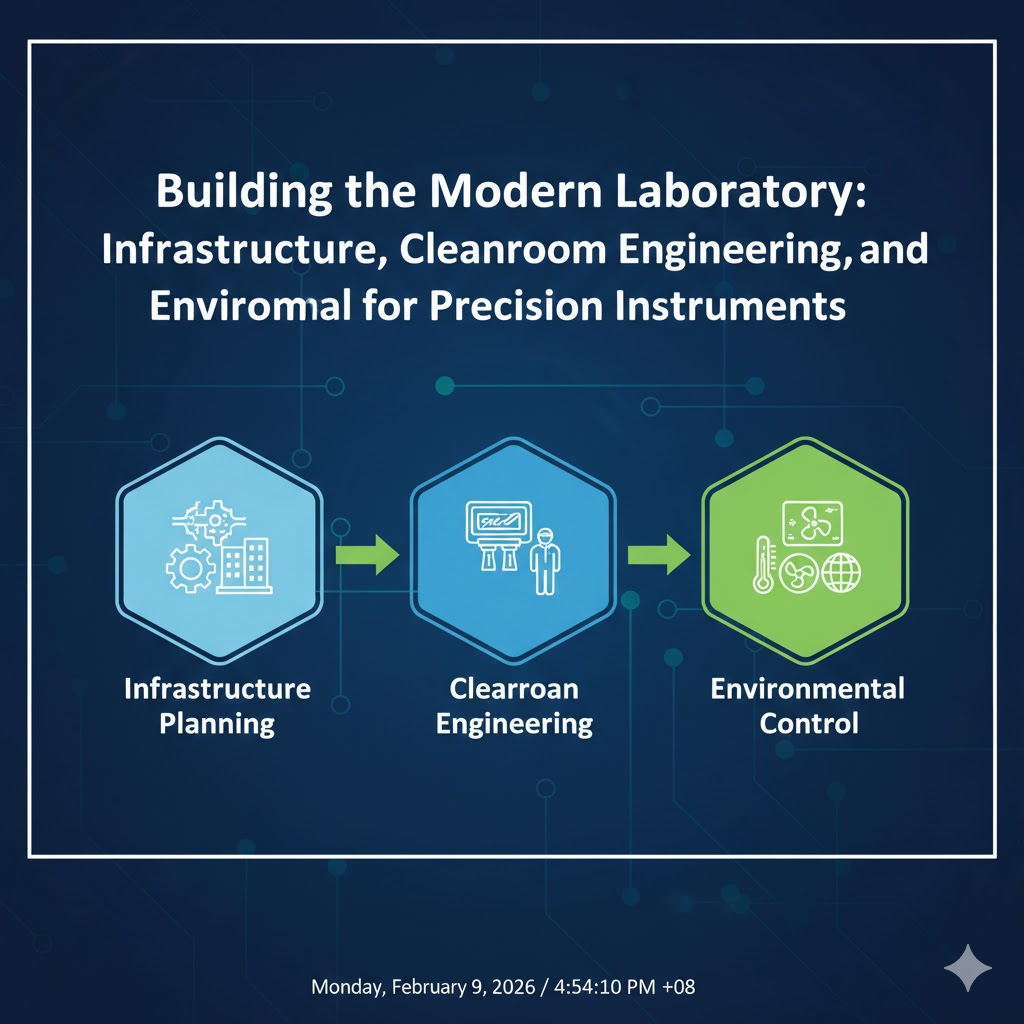
Modern laboratories are no longer “rooms with benches.” They are engineered production environments for data—where air quality, vibration, temperature stability, and utility reliability directly affect instrument performance, sample integrity, and regulatory compliance. For building owners and operators, the business case is clear: a well-planned lab reduces downtime, protects high-value instruments, improves reproducibility, and scales future capacity with fewer retrofits.
A practical sign of this broader shift is that even “non-core” operational systems—like foodservice and waste handling inside science parks—are being redesigned to align with contamination control and sustainability targets. That is why solutions like Bioleader High-performance Sugarcane Containers increasingly appear in modern lab campuses and adjacent facilities: they fit operational goals (hygiene, standardization, waste diversion) without turning sustainability into a performance compromise.
1) Start With the Lab’s “Performance Specification,” Not the Floor Plan
The most common mistake in lab construction is designing the space first and trying to “engineer in” performance later. A modern lab should start with a performance specification that answers four investor-grade questions:
- What instruments will be installed—and how sensitive are they?
Examples: LC-MS, electron microscopy, PCR/qPCR suites, cell culture, NGS prep, microbalance weighing, and spectroscopy all have different environmental tolerances. - What workflows dominate the facility?
Analytical QC, wet chemistry, biosafety, microfabrication, or multi-omics each drive different zoning, ventilation, and material requirements. - What regulations and standards apply?
Common frameworks include ISO cleanroom standards (ISO 14644 series), GMP-like expectations for controlled areas, and biosafety requirements (BSL-2/BSL-3) where relevant. - What is the expansion strategy?
A lab built for the present only becomes obsolete quickly. Designing for modular utilities and scalable air systems protects capital.
Business outcome: When the specification comes first, your engineering team can make disciplined decisions about HVAC capacity, filtration, pressurization, and structural isolation—preventing expensive “late-stage fixes.”
2) Cleanroom and Controlled-Environment Engineering: What Actually Matters
Cleanrooms are not just about “clean.” They are about controlled particle concentration and predictable airflow behavior.
ISO Classes and Practical Targets
Many life science and analytical facilities use ISO 14644 classifications as a common language. ISO 5 is highly stringent, while ISO 7–8 are more typical for supporting areas and clean-adjacent corridors. The right class depends on process risk, not prestige.
HEPA Filtration and What It Really Delivers
A common baseline is HEPA filtration at 99.97% efficiency for 0.3 µm particles, paired with well-designed air distribution. However, filtration alone doesn’t guarantee control. The airflow pattern (laminar vs. mixed) and room pressurization are equally important.
Air Changes Per Hour (ACH) and Energy Reality
Cleanrooms typically run high ventilation rates. Many controlled areas operate in the 20–60 ACH range depending on classification and process, which can dominate operating costs. This is why modern facilities increasingly adopt:
- demand-based ventilation (where permitted)
- VAV strategies with safety constraints
- heat recovery and smarter fan control
- zoning that limits high-ACH to truly critical areas
Business outcome: Over-designing clean air is a permanent utility tax. Right-sizing cleanroom intensity to actual risk is one of the highest-ROI decisions in lab construction.
3) The Environmental Requirements Precision Instruments Won’t Forgive
Precision instruments convert physics into data. The more sensitive the measurement, the more the environment becomes part of the instrument.
Temperature Stability (Not Just Setpoint)
Many labs target 20–24°C for comfort and equipment norms, but high-precision instruments often require tight stability over time—sometimes far more important than the exact number. Rapid fluctuations can cause drift, baseline noise, and measurement variability.
Best practice: Design for low rate-of-change (slow, stable control) rather than aggressive cycling.
Humidity Control and Condensation Risk
Relative humidity often sits in the 40–60% zone to balance comfort, static control, and microbial considerations. Yet humidity is also a corrosion and condensation risk, especially where cold surfaces, chilled water lines, or cold rooms are present.
Best practice: Control dew point carefully and insulate/route cold utilities to prevent hidden condensation.
Vibration: The Silent Data Killer
For sensitive imaging, microbalances, AFM, or electron microscopy, vibration is frequently the limiting factor. Sources include:
- mechanical equipment (fans, pumps, compressors)
- structural resonance from footfall
- nearby roads, rail, or construction
Best practice: Early structural planning (slab thickness, isolated pads, equipment placement) is cheaper than retrofitting isolation later.
Electromagnetic Interference (EMI)
High-frequency electronics, MRI-adjacent facilities, or dense power distribution can create EMI issues that degrade signal quality.
Best practice: Plan equipment rooms, cable pathways, grounding, and separation distances early—EMI problems are notoriously expensive to diagnose after occupancy.
4) HVAC as the “Operating System” of the Lab
In a modern lab, HVAC is not just comfort—it is the operating system for safety and data quality.
Pressure Cascades and Containment
Pressure differentials guide airflow direction to protect people and samples. Typical strategies include:
- positive pressure for clean areas that must be protected from infiltration
- negative pressure for containment areas (e.g., pathogen work) to protect adjacent spaces
Exhaust, Fume Hoods, and Make-Up Air
Fume hoods can be the single largest driver of energy consumption in a chemistry-heavy building. High hood density requires:
- robust exhaust capacity
- reliable make-up air
- careful control to prevent pressure instability
Best practice: Right-size hood counts, adopt high-performance hood designs, and implement operational discipline (sash management) where feasible.
Redundancy and Reliability
For critical labs, “N+1” redundancy in key HVAC components and power supply is often justified. A short outage can invalidate experiments, spoil samples, or stop production workflows.
Business outcome: Reliability engineering is not a luxury; it’s a cost-avoidance strategy that protects the value of experiments, staff time, and instrument uptime.
5) Utilities Planning: The Hidden Backbone of Lab Productivity
A lab’s utility matrix is more complex than most commercial buildings.
Electrical Power Quality
Precision instruments are sensitive to voltage dips, harmonics, and sudden outages. Consider:
- UPS for critical instruments and IT
- clean power where required
- surge protection and structured grounding
Water Systems: Purity, Loops, and Risk
Many labs need multiple water grades—potable, softened, RO, DI, and sometimes ultrapure. Key decisions include:
- centralized vs point-of-use generation
- loop design to prevent stagnation
- monitoring for conductivity and microbial risk
Specialty Gases and Distribution Safety
Nitrogen, CO₂, compressed air, and other gases require safe storage, detection, ventilation, and zoning. Poor routing decisions can create long-term safety constraints.
Business outcome: Utility design determines how quickly the lab can onboard new instruments and workflows without disruptive renovations.
6) Materials, Surfaces, and “Cleanability by Design”
Lab finishes are not an aesthetic choice. They are a contamination-control strategy.
- Non-porous, chemically resistant surfaces reduce absorption and ease cleaning.
- Coved flooring and sealed penetrations prevent particle traps.
- Low-shedding materials support controlled environments.
- Simplified geometry reduces maintenance labor and failure points.
This “cleanability by design” mindset extends to operational areas too—break rooms, cafeterias, and waste stations inside science parks increasingly standardize consumables that reduce mess and improve waste sorting. That is one reason molded-fiber solutions like Bioleader High-performance Sugarcane Containers show up in modern facilities as a practical, operations-friendly option rather than a branding exercise.
7) Commissioning, Qualification, and Ongoing Maintenance: Where ROI Is Won or Lost
A lab building is not “done” at handover. It must be proven.
Commissioning (Cx) as a Business Requirement
Commissioning validates that systems operate as intended under real load, including:
- airflow performance and pressure relationships
- temperature/humidity stability
- alarm behavior and failure recovery
- filtration integrity checks (where required)
Performance Monitoring and Drift Control
Over time, filters load, sensors drift, dampers stick, and occupancy changes. Facilities that maintain performance typically invest in:
- calibrated sensors and documented intervals
- trending dashboards for temperature/RH/pressure
- preventive maintenance schedules based on risk
- rapid response protocols for excursions
Business outcome: A lab that drifts out of spec produces hidden costs: repeated experiments, instrument downtime, failed audits, and staff inefficiency.
8) Strategic Conclusion: Build Labs Like Data Factories
From a building-business perspective, the modern lab is best viewed as a data factory. That framing drives better investment decisions:
- Cleanroom intensity should match risk, not ambition.
- HVAC must prioritize stability and directional control, not just capacity.
- Structural and utility planning should anticipate instrument sensitivity and future expansion.
- Commissioning and monitoring are not optional; they protect asset value.
- Operational design—from waste handling to daily consumables—should align with contamination control and sustainability objectives.
The labs that outperform are the ones designed as integrated systems. They deliver reproducible science, predictable operations, and an infrastructure platform that can absorb new instruments, new workflows, and new compliance demands without constant reinvention.
If you’d like, I can also produce a short “facility planning checklist” version (one-page style) suitable for building owners to use during early-stage lab project scoping—still consistent with BuildingBusinessNews editorial tone.
