
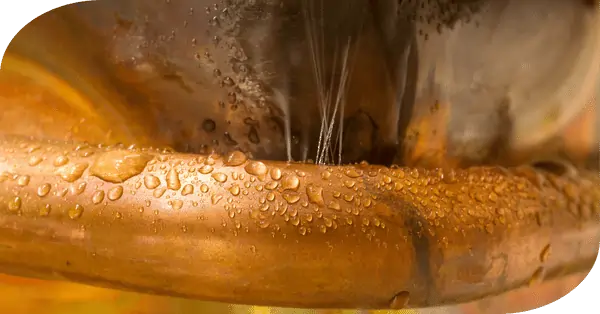
A single pinhole leak loses roughly 250 gallons of water per day. Most homeowners never notice until there is visible mold, a sagging ceiling, or a water bill that suddenly looks like a mortgage payment. By then, the damage has been accumulating for months, sometimes longer, quietly rotting the structure of the home from the inside.
This is the reality for thousands of Houston-area homes built between the 1970s and early 2000s. The copper pipes inside those walls looked bulletproof at installation. Decades later, they are anything but. And the way they fail, gradually, silently, through microscopic perforations, makes them far more destructive than a dramatic burst pipe ever could be.
Understanding why copper pipes fail in Houston specifically, and what happens if homeowners delay acting, is the difference between a planned repair and an emergency gut renovation.
What Actually Causes Copper Pinhole Leaks
Houston’s Water Chemistry Is a Major Factor
Copper does not corrode randomly. It reacts. And Houston’s water supply gives it plenty to react with.
The water across much of Harris, Montgomery, and Fort Bend County is moderately hard, carrying dissolved minerals like calcium and magnesium bicarbonate. That mineral load, combined with chloramine disinfectants used by the municipal supply, creates conditions that accelerate pitting corrosion inside copper pipes over time. Pitting corrosion is not surface-level. It bores inward from the pipe wall, creating deep pockets that eventually punch through, producing those signature pinhole failures.
According to the American Water Works Association, chloramine-related copper corrosion has been identified as a contributing factor in premature pipe failure in numerous Sun Belt metro areas, Houston included.
The Age Factor Nobody Talks About Enough
Copper pipe has a rated service life of roughly 50 years under ideal conditions. Houston’s conditions are not ideal.
Homes in Katy, Kingwood, Sugar Land, and Bellaire that were built in the 1980s are now sitting at 40 to 45 years of service. That puts them squarely in the window where pitting corrosion has had enough time to work through the pipe wall in multiple locations. The first leak gets patched. Then another appears six months later. Then another. What feels like bad luck is actually the entire system announcing that it is reaching the end of its service life.
High Flux Solder Residue
Older copper installations often used high-flux solder at the joints. Over decades, flux residue sitting inside the pipe accelerates localized corrosion at those exact points, which is why pinhole leaks frequently appear at or near fittings rather than in the middle of a straight run. Homeowners and even some plumbers misread this as a joint failure, when the underlying cause is internal chemical breakdown.
The Hidden Damage You Are Not Seeing
Mold Grows Fast Behind Walls
Drywall stays damp, and mold can colonize a surface within 24 to 48 hours of sustained moisture. A slow pinhole leak inside a wall cavity creates exactly that environment. Because the leak rate is so low, it never causes enough visible wetness to trigger alarm, but the moisture keeps the cavity humid enough to sustain mold growth for months.
By the time a homeowner notices a musty smell or a soft spot on the drywall, the mold colony behind it can be substantial. Mold remediation in a single room typically runs between $500 and $3,000 depending on scope. In severe cases, especially those involving HVAC ducts or subfloor penetration, that cost climbs significantly higher.
Structural Wood Damage
Ceiling joists, wall studs, and subfloor sheathing are all vulnerable to sustained moisture. Wood rot does not announce itself. It progresses slowly until the structural integrity of the affected member is compromised. In slab-on-grade homes common across Houston, a leak that runs along the slab before wicking upward can saturate floor sheathing and bottom plates without ever producing a visible wet spot on the surface floor.
The Cost of Repeated Patch Repairs
Here is a number worth sitting with: a service call to patch a single pinhole leak typically costs between $150 and $400 depending on pipe access and location. Three of those repairs in 18 months adds up to more than $1,000, and the underlying pipe system is no more reliable at the end of it. The patches address symptoms. The corrosion causing those symptoms is still active throughout the rest of the system.
Homeowners who have been through two or more spot repairs in the same home are almost always dealing with a systemic problem, not isolated incidents.
Copper vs. Modern Alternatives: What Homeowners Are Switching To
For anyone weighing whether to keep patching or address the whole system, understanding the material options matters. A detailed breakdown of the differences between copper pipes and modern PEX alternatives is worth reviewing before making any decision, because the performance gap between aging copper and current-generation PEX-A is more significant than most people expect.
Why PEX-A Has Become the Standard for Repipes
PEX-A, particularly Uponor’s product line, uses an expansion fitting system that creates a joint stronger than the pipe itself. It does not pit. It does not react to chloramines. It handles the thermal expansion and contraction cycles that Houston’s climate demands without fatiguing at the fittings.
PEX-A is also substantially more forgiving in a freeze event than copper or standard PEX-B. For areas north of Houston toward The Woodlands, Spring, and New Caney that occasionally see hard freezes, that flexibility is genuinely meaningful, not just a marketing point.
Copper, when it is performing as designed, is an excellent pipe material. The problem is that copper installed 35 to 45 years ago in Houston’s specific water chemistry environment is not performing as designed anymore.
The Warning Signs That Usually Get Dismissed
Most homeowners experiencing early-stage pinhole leaks attribute the symptoms to something else entirely. Here is what to watch for:
- Water pressure dropping gradually over months: Internal corrosion and mineral buildup narrow the pipe bore over time. The change is gradual enough that many people adapt to it without registering that the shower pressure they have now is a fraction of what it was five years ago.
- Discoloured water at first use: A brief orange or brownish tinge when a tap is first opened after sitting overnight suggests oxidation inside the pipe walls. It often clears within a minute, which leads homeowners to dismiss it.
- Unexplained spikes in water bills: A 10 to 20 percent increase in monthly water consumption without a corresponding change in usage habits is a flag worth investigating.
- Recurring damp smell in specific rooms: Localised musty odor in one area of the house, particularly near exterior walls or under sinks, often traces back to a slow active leak somewhere in that wall cavity.
- Visible verdigris (green staining) at pipe fittings: Green or blue-green buildup at exposed copper joints in utility areas is a visible sign of active corrosion chemistry.
Any one of these might be explainable in isolation. Multiple symptoms appearing together in a home over 25 years old is a pattern worth taking seriously.
What a Whole-House Repipe Actually Involves
Scope and Timeline
A full repipe on a typical Houston home replaces every water supply line, from the main entry point through to each fixture and outlet throughout the house. Access holes are cut at strategic points in the drywall to run the new pipe. The old copper is either capped off or removed depending on routing.
Most whole-house repipes on Houston residential properties are completed in one to two days. Water is typically restored at the end of each working day, so the disruption window is usually five to six hours rather than a multi-day outage. Homeowners do not need to book a hotel or find alternative accommodation.
The Drywall Question
Access holes are unavoidable. Any company that claims otherwise is either cutting corners on the installation or misleading you about the method. The relevant question is who restores the walls afterward.
Many contractors leave drywall patching to the homeowner or expect them to hire a separate trade. That coordination is a real burden, especially when the textures need to be matched to existing wall finishes. Some repiping specialists include drywall repair and paint as part of the project scope, which eliminates the coordination problem entirely and leaves the home in finished condition once the job is complete.
Permits and Pressure Testing
Any legitimate whole-house repipe in Texas requires a permit and a final pressure test. The pressure test confirms there are no installation errors before the walls are closed. Unlicensed or underpriced contractors sometimes skip the permit process to reduce overhead and speed up scheduling. That shortcut creates real liability for the homeowner, particularly during insurance claims or when the home is sold and a buyer’s inspector pulls permit history.
When to Stop Repairing and Start Replacing
The honest answer: if a home’s copper supply system has produced two or more pinhole leaks in the past two years, or if the home is 30-plus years old with original copper piping and any of the warning signs described above are present, the repair-versus-replace math almost always favors replacement.
The cost of a whole-house repipe in the Houston market ranges broadly from roughly $4,000 to $16,000 depending on home size and fixture count. Against the cumulative cost of repeated patch repairs, mold remediation, drywall damage, and potential structural issues, the repipe often pays for itself in avoided damage within a few years.
Companies like Repipe Solutions Inc that specialize exclusively in repiping rather than treating it as an occasional add-on service tend to be more efficient on both timeline and pricing, because it is work they complete every day rather than every few months.
Key Takeaways
- Copper pinhole leaks are caused by a chemical interaction between the pipe material and Houston’s specific water chemistry, particularly chloramine content. They are not random, and they get worse over time.
- The hidden damage from a slow pinhole leak, mold, wood rot, structural moisture, almost always costs more to remediate than the leak repair itself.
- Repeated patch repairs on a 30-plus-year-old copper system are not a long-term strategy. Each fix addresses one failure point while the underlying corrosion continues throughout the system.
- PEX-A is the current standard for whole-house repiping because it does not pit, does not react to chloramines, and handles Houston’s thermal cycling better than copper or lower-grade PEX variants.
- A whole-house repipe is typically completed in one to two days with only a few hours of water downtime per day. It is far less disruptive than most homeowners expect.
Frequently Asked Questions
How do I know if I have an active pinhole leak if there is no visible water? Check your water meter with all fixtures turned off. If the meter dial or digital display is still moving, water is flowing somewhere it should not be. A licensed plumber can follow up with a pressure test to isolate the location.
Can I just replace the worst sections of copper pipe rather than the whole system? Partial replacement is sometimes appropriate for younger pipe systems with isolated damage. For homes where the copper is 30 to 40-plus years old and multiple leaks have already occurred, partial replacement trades short-term cost savings for longer-term risk. The same corrosion that caused the known leaks is active throughout the rest of the pipe.
Does homeowner’s insurance cover copper pinhole leak damage? Coverage varies significantly by policy and insurer. Most policies cover sudden and accidental damage but exclude damage from gradual leaks that the homeowner should have detected and addressed over time. Documentation of when the leak was discovered and the response timeline matters considerably when filing a claim.
What is the difference between PEX-A and standard PEX, and does it matter for a repipe? PEX-A uses a crosslinking process that makes it more flexible, more uniform in its expansion properties, and produces a stronger joint connection than PEX-B or PEX-C. For a whole-house repipe expected to last decades, the material grade is worth specifying. Uponor’s PEX-A is widely regarded as the premium standard for residential repiping.
How long does a whole-house repipe warranty typically last? This varies by contractor. Some offer limited warranties of five to ten years. Others, particularly repipe specialists, offer lifetime warranties that are transferable to a new owner, which adds measurable value if the home is ever sold.
Conclusion
Copper pinhole leaks are not a plumbing inconvenience. They are an early signal that a pipe system is entering its final chapter, and the homes they affect silently absorb the cost every day that action is deferred.
Houston’s water chemistry, heat, and aging housing stock create a specific set of conditions that make this a more common and more urgent problem here than in many other regions. Knowing the warning signs, understanding what a repipe actually involves, and getting a proper assessment before the first visible water damage appears is the practical approach.
If the symptoms described here sound familiar, getting a proper assessment and a clear, fixed-price quote is a reasonable next step. You can request a repipe solution through a no-obligation consultation, which gives you concrete information to make the decision on your own timeline rather than under emergency pressure.
